Friday, January 31, 2014

Aimee Mullins Changes the Wor[l]d


We love Aimee Mullins! 

This Paralympic record-breaker, model, and activist is an intelligent and inspiring role model who, in this video, makes a powerful argument for the dismissal of common word associations in order to create empowered, rather than broken, individuals. It's a somewhat long video, so I'm going to keep the writing to a minimum. Enjoy and share your thoughts!

"There's an important difference and distinction between the objective medical fact of my being an amputee and the subjective societal opinion of whether or not I am disabled. And, truthfully, the only real and consistent disability I've had to confront is the world ever thinking that I could be described by any of those definitions."


Have a great weekend (and if you haven't already, take a look at last week's post before you enjoy the SuperBowl this Sunday)! 

Friday, January 24, 2014

Correspondence with Coleman: Seahawks Fullback Makes a New Friend


The Seattle Seahawks have been quite the buzz lately, and, perhaps oddly, they have made their way into this blog as well. However, This story has nothing to do with the Super Bowl. In fact, it has little to do with football at all. This story is about Seahawks fullback Derrick Coleman and his recent correspondence with one of his biggest little fans and her twin sister.

Two weeks ago, Duracell dropped an advertisement featuring Coleman and his inspiring life story. 


Coleman is the NFL's first legally deaf offensive player. He has been deaf since he was three years old and requires hearing aids in order to make out most sounds. During his final two seasons at UCLA, before getting offered a spot in Seattle, Coleman rushed for more than 1,200 yards and scored sixteen touchdowns. Still, evaluators worried that his hearing impairment would effect his play. Former UCLA coach Rich Neuheisel insisted that Coleman's disability was not a problem and in fact made him a very conscientious and self-sufficient player. Coleman went undrafted, but was eventually offered a spot on Seattle's practice team in December 2012. He took the opportunity to prove himself.

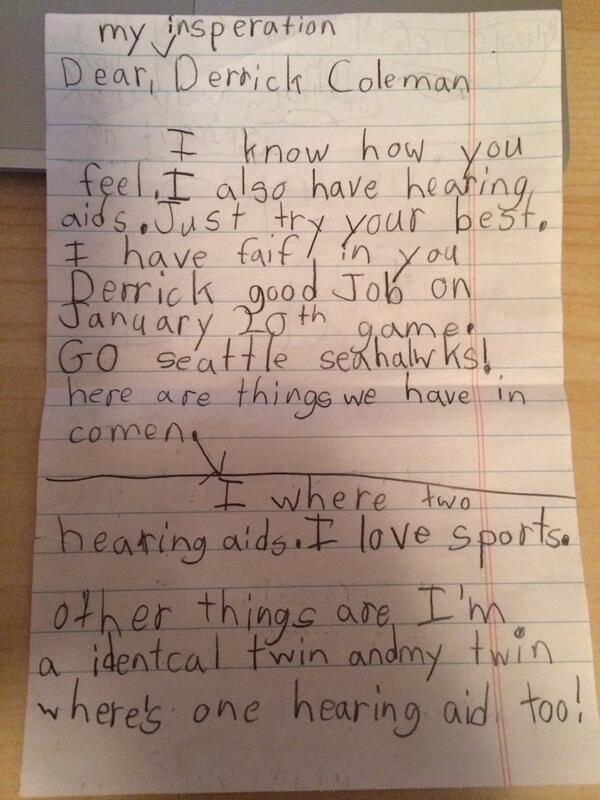
After seeing the Duracell commercial, a little girl who is also deaf wrote a letter to Coleman. The empathy and genuineness of this letter is incredibly endearing.


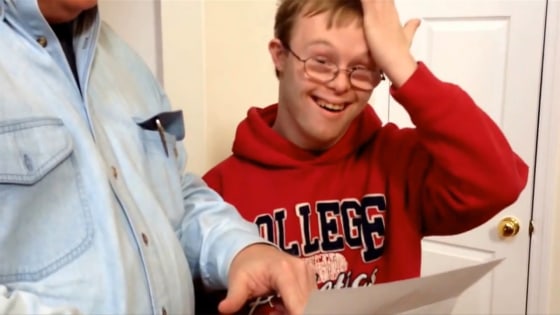
And then Coleman wrote back:


Never underestimate the power of a handwritten letter! I hope you've had a smile today and have many more throughout the weekend.

Friday, January 17, 2014

Racing in Reno: A Brief Story of Friendship, Track, and Sportsmanship


Today I'm passing on a little love from my hometown, Reno. I'm really excited to share this story with all of you because one of the young men involved, Drew Rippingham, is the son of my third grade teacher. Drew and the other boy, Jack, are currently students at my old high school, and the middle school track program mentioned is also something I was part of back in the day. So this story feels very personal to me, and I hope it makes you smile, too.

Last year, then-eighth graders Drew Rippingham and Jack Rovetti developed a strong friendship thanks to a shared love of track and field. Both boys participated in the sport at Swope Middle School in Reno, NV and competed in the same event.

The two boys didn't know each other before the beginning of track season, but at the first meet, Drew noticed that Jack, who has Down Syndrome, looked a little lost.

"At that first track meet, Jack was standing in a group of kids waiting for his race and didn't really know where to go,” said Diana Rovetti, Jack's mom. “This kid (Drew), on that day, said, 'Come race with me.' At every single meet after that, he ran next to Jack in the heats. He's a really good athlete. He could have been winning these races, but he ran beside Jack and encouraged him. He did this on his own."

Drew and Jack at a meet.
The boys finished every heat together. Drew, however, was not satisfied with Jack simply finishing the races; he wanted Jack to know the joy and excitement of crossing the finish line before anyone else. He wanted his friend to win.

When the last race of the season arrived, Drew talked to all of the other competitors in the race and told them about Jack. When he asked how they felt about helping him let Jack take the win, all the boys agreed.

Six boys lined up for the start of the 100 meter dash: four from other local middle schools, then Jack, then Drew. The gun sounded, and they all took off. Jack took the lead, and as he crossed the finish line, his fellow competitors circled around him and showered him with high fives, slaps on the back, and congratulations.

"It was very touching," said Jim Rippingham, Drew's father. "There were a lot of tears, to tell you the truth, once people in the stands kind of figured out what was happening."

Yes, the race was fixed, but that's not the point. A 14-year-old boy got a group of other 14-year-old boys to set aside their competitive nature and do something nice for another student without expecting to gain anything in return. Selfless is not typically a word used to describe middle school boys, but here is this group of young human beings being nice to another human being, bonding and growing over a shared interest. It's fantastic.

Even though nothing was expected in return, Drew and Jack's friendship and the story of their final race just earned Swope Middle School's track program a $1000 grant from Liberty Mutual Insurance and the Positive Coaching Alliance as one of the “Top 10 Responsible Sports Moments” of 2013. That's the power of friendship!

Friday, January 10, 2014

Camper Story - "Michael George: The Entertainer"


A little while back, we posted on the Kiwanis Capstone Facebook page that there would be some exciting content changes regarding this blog. Today, we bring you the first of those changes!

At the end of every camp session, some counselors get the opportunity to interview their campers and their campers' families. The stories that come out of these interviews give a unique look at what camper life is like outside of camp. Most campers and counselors only get to know one another within the context of MHKC, so these camper stories are super rad. 

What follows is the beginning of one of these stories, written about camper Michael George. The full story will be posted soon on the MHKC Capstone website; we will keep you updated! For now, here's a little teaser to give you lovely readers an inside look at camper life:

Michael George: The Entertainer


Dinner ends and people filter out of Fanning Hall to the small amphitheater-shaped collection of rustic wooden benches facing a stage where campfire is held each evening. The audience is soon filled with animated campers, singing and dancing, with coordinating hand movements to a song about a tree in a bog. "Rattlin' Bog" is a camp favorite, and is usually sung at one of the first campfires of the week. As the chorus begins, the excitement builds, the volume picks up, the dancing becomes increasingly enthusiastic as it reaches the catch phrase of the tune: "Bog down in the valley-o!" One voice rings louder than the rest, and that voice belongs to Michael George.
Anybody who has been at Mt. Hood Kiwanis Camp with Michael would easily recognize and remember him. Michael is a performer. Being on stage or in front of a group is something Michael is not only very comfortable with, but also something he loves. 
Whether it is performing a skit with the campers in his group or leading a camp song, Michael shines in the spotlight. 
When Michael has the chance to perform, he's not just singing and dancing. Michael also enjoys playing musical instruments. He has taken music lessons in both harmonica and guitar, and has participated in choir. When Michael comes to camp, he brings his ukulele and sings on stage with the Kiwanians during BBQ dinner the last night of camp.
Michael has loved music all his life, and he particularly loves classic rock--All kinds of classic rock. Jimmy Buffett and Billy Joel are two of Michael's favorite artists, but he especially loves The Beatles. He has many favorite Beatles songs, and really loves the song "Twist and Shout." On a recent trip to Las Vegas with his family, Michael got to see a Beatles tribute group perform. Even more exciting is during the performance "Paul McCartney" pulled Michael on stage to sing, dance, and play the tambourine.


There you have it, folks! Our fun little teaser. I hope it's a welcome change from our usual content and gives you a fuller understanding of why we love Mt. Hood Kiwanis Camp. Remember, we will let you know here and on Facebook when the full story is up.

Have a wonderful weekend!

Saturday, January 4, 2014

99 Problems: A Comedic Look at CP


I was going to write about Melissa Shang, a little girl from Pennsylvania who has muscular dystrophy and is petitioning to get American Girl to make a doll who looks like her, but I came across this funny and poignant video that I would rather share (especially since the American Girl story has been going around for a while).

Of the TED Talks shared on this post, I think this one is my favorite. Maysoon Zayid is a writer, actor, and comedian with cerebral palsy. This video touches on disability, race, sex, religion, Hollywood, and discrimination, but all with a humorous flair. In spite of various forces wedging their way between Zayid and her dreams--like the role of a girl with cerebral palsy being given to an able-bodied girl rather than Zayid--she kept her sense of humor and pushed through until she reached her goals. She is a rad lady!

Give it a look and share your thoughts!

Friday, December 27, 2013

"They Said Yes!": A College Acceptance


Do you have post-holiday blues? Or maybe you're in good spirits and would like to stay that way? Luckily Mt. Hood Kiwanis Camp at Portland State has just the pick-me-up/keep-me-going for you!


Rion when he hears the good news.
Rion Holcombe wasn't home when the envelope from ClemsonLIFE at Clemson University arrived, but his parents, Danny and Susan Holcombe, were. They knew that Rion, who has Down Syndrome, had been accepted to Clemson and were ready with camera when Rion eventually received the good news himself.

“I got accepted? They said yes?” Rion asks in tones of excited disbelief.

“They said yes!” Danny says. “What do you say?”

“Yes! This is crazy!”


Rion's parents say they are very excited for their son, but as parents, they are “not real excited about him leaving home.” However, they are extremely happy and thankful that their son actually has the opportunity to go to school, noting that at the time he was born, this would not have been possible.


ClemsonLIFE is a two year program at Clemson University in South Carolina that is specially designed for students with intellectual disabilities. It gives students the opportunity to live independently on campus while incorporating functional academics, employment skills and opportunities, social and leisure skills, counseling, and self-advocacy.

Rion couldn't be more excited to be part of the program.

“He's not looking back at all,” Danny says. “We asked him if he'd miss us, and his response was, 'Maybe eventually!'”


Friday, December 20, 2013

BlindSide: A Video Game Without Video


I am not a gamer by any means, and I'm not really up to date on the new consoles and technologies and what have you; Nintendo 64 is about all I can handle. However, my attention has just been caught by an awesome sounding (in more ways than one) thriller-horror game called Blindside.

BlindSide is an audio-only survival horror video game that doesn't actually feature any video. While many video games have accessibility options built into their programming, especially games for phones and tablets, BlindSide was designed specifically for the visually impaired.

In the game, Case, an assistant professor, and his girlfriend, Dawn, wake up inexplicably sightless. They aren't the only ones, either. Everyone in the city has become blind and must survive the menacing-sounding monsters that now roam around. Players must navigate Case by using audio cues from both Case and the environment. For example, since Case is new to being blind, he bumps into things around him and gives verbal hints about what he feels: “The door is to my left.” 

Environmental cues might be the sound of traffic as one approaches a window and the speaker in which those sounds are heard depending on the direction one turns. If one faces the window directly, sounds are heard in both ears, but if one turns to the right, the sound is isolated to the left speaker. Also, if using mobile devices, players can actually move themselves in order to move Case, rather than being confined to arrow keys on a computer. This element of mobility seems to help players, particularly sighted ones, get a clearer mental image of the environment.

Start screen for BlindSide's mobile app.

BlindSide was designed after Aaron Rasmussen, half of BlindSide's development team, was temporarily blinded after a red phosphorous and potassium chlorate explosion. After the emergency room drugs wore off, Rasmussen woke up to blackness. His corneas eventually grew back, but Rasmussen doesn't take advantage of his sight anymore: “The whole experience made me value my sight more, in a way that makes me treat it with more care.”

Rasmussen got together with a former colleague from Boston University, Michael T. Astolfi, and after raising over fourteen thousand dollars on Kickstarter in December, 2011, the two worked from their homes in Los Angeles (Rasmussen) and New York (Astolfi) for the next twelve months. They modeled real-world locations in 3-D and reproduced over a thousand sounds that would be heard in those environments, adjusting them to walk the line between authenticity and playability.

BlindSide won an innovation award at the Games for Change Festival in June and has been downloaded thousands of times on iOS and PC since its release last year. Rasmussen and Astolfi have no plans of making a sequel to the game, but they have helped the Smith-Kettlewell Eye Research Institute make an assistive app using the game's technology, and they hope that other gamers and independent game designers will continue designing accessible games that don't feel limited.

BlindSide is available at the iTunes App Store for $2.99 or on the BlindSide website for $3.99.

I'm extremely tempted to try it out; rumor has it BlindSide is pretty scary. Sounds good to me! What do you think?