Friday, July 25, 2014

Department of Justice Proposes Movie Theater Accessibility


Movie theaters might be getting an accessibility facelift in the near future!

According to officials at the U.S. Department of Justice, new rules regarding captioning and audio description in theaters have been proposed in compliance with the Americans with Disabilities Act. Many theaters currently have captioning and audio description devices already available for those who request them, but the new rules would set a national standard for accessibility.

At the moment, the proposal would apply to digital screens (these movies are produced with captioning and narration features), requiring theaters to provide a certain number of accessibility devices. However, officials are considering whether or not to apply these rules to analog screens as well.

Assistant attorney general for civil rights at the Justice Department, Jocelyn Samuels, says that even as the 24th anniversary of the Americans with Disabilities Act approaches, many people within the disability community to not have full access to all aspects of American life.

“Although some movie theaters are making strides towards meeting their ADA obligations, there is a good deal of inconsistency among theaters across the United States.” Samuels says. “This proposed rules is intended to ensure that, regardless of where a person with a hearing or vision disability lives, that person will be able to attend movies with their friends and family and fully enjoy this important social and cultural activity.”

There are exceptions to the new proposal, like for drive-in theaters that would require considerable alteration for compliance.

Officials say the proposal will soon be published in the Federal Register, at which time there will be a 60-day public comment period.


What do you think? Have you ever been to a theater that didn't offer accessibility devices? (The first time I learned about accessibility devices was a couple years ago here at the Portland Art Museum during Kinofest Northwest, a German film festival. Before that time, I never knew!)

Friday, July 18, 2014

Same but Different


I swear it happens every year. Right around midsummer, I find myself wrapped up in beautiful little short films. I try to resist putting too many videos on this blog, but I do love the visual element they add, and some of them are too well done not to share. 

So, because I can't help myself, below is the link to a video that is part of the Emmy and BAFTA nominated series, "Same but Different", directed by David Barnes and Louise Lynch and broadcast on BBC2.


Because of rights issues, the video won't play directly on this blog, but give the box a click, and it'll send you over to Vimeo without a hitch.

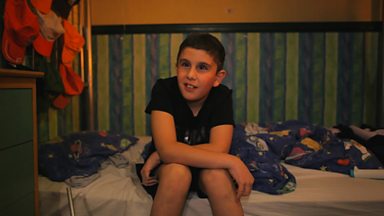
This particular portrait is of Theo, a ten year-old boy who is visually impaired. His disarming honesty and matter-of-fact attitude are both poignant and light, and the treatment of disability in this video is pretty neat. It seems that in portrait documentaries like this, documentarians tend to push the focus away from the disability and on to the person instead, which is generally nice. But this film seems to do it the other way around. Theo talks about his life as it relates to his visual impairment, but through that exposition, his personality dominates the film in a wonderful way. 

Take a look! And sorry about the tricky link issue. :)


Same but different - Theo's Story from David Barnes on Vimeo.

Friday, July 11, 2014

Exploring the Variant Body


Da Vinci's Vitruvian Man, the Canon of Proportions, shows the ideal symmetrical balance of the human body. Art students know this. However, of course, a strict rehashing of canonically proportioned human bodies would leave the art world a boring, nonrepresentational place.

Riva Lehrer, artist and anatomy professor, brings together—wait for it—art and anatomy to explore diversity in human forms, the “variant body”.

In medical museums, subjects of abnormal anatomical study are found in jars, preserved in formaldehyde, and labeled with only a diagnosis. They are useful, and Riva Lehrer, anatomy professor, knows this. But Riva Lehrer, artist, also wants to connect the actual humans with their disabilities and diagnoses. She wants to bring out the narratives that are stripped away from bodies on display.


“I'm not interested in shutting down these museum displays,” she says. “I'm interested in pulling people into as deep an understanding of body variance as possible.”

Part of Lehrer's interest stems from her own experience. During a visit to the Mütter Museum, walking through rows of anatomical specimens, she found herself facing a shelf full of spina bifida examples—a shelf full of her own body.

“I realized I was looking at the slipstream of my own alternate history,” says Lehrer, also noting that had she been born earlier or elsewhere, she, too, could have ended up as a teaching tool.


It's easy to look at a body part in a jar as a specimen of study, but Lehrer stresses the importance of keeping biography with the body, which is something she thinks having art in medical museums would do.

“It matters to doctors deciding what to do. It matters when a genetics counselor talks to prospective parents. It matters when a politician makes a law. Above all, it matters to that disabled person, standing in from of a glass case full of jars.”


Check out Lehrer's website for more pictures and information about her various projects. They're rad!

Saturday, July 5, 2014

Conflict of Inspiration


This week's post strays somewhat from the tone of our usual posts, but it is something that I personally find very important and relevant, especially given the kinds of things I do with the social media aspect of the Portland State University Mt. Hood Kiwanis Camp capstone.

So, just a little disclaimer, this post is representative of my point of view, not necessarily the points of view of all people associated with MHKC or the MHKC capstone.

I was looking on the Humans of New York Facebook page earlier this week, and at the top was a photo of a man without an arm, carrying his garbage. “No struggles,” he said. Something about the implication of the image and the chosen quote were off-putting to me (though I couldn't say why), and as I glanced to the left of the screen, I saw I wasn't the only one to feel this way.

I read on, followed the link to the video (conveniently embedded below!), and thought, “Yes! That's it!”

(Apologies for the poor photo quality. Click the embedded links above for original sources.)


I consider it part of my job to find neutral-positive things to post in order that people will see them, think, “I agree with that,” or, at the least, “I don't disagree with that,” and then 'like', share, or comment, which helps spread the MHKC name and the PSU capstone. I want to educate people about social stigma and promote disability and ability awareness and perpetuate the idea that variation is the norm. However, the social media world is fast-paced: eye-catching images with a few words that sit well in the minds and hearts of an audience; maybe five seconds of interaction between that audience and a given image; then the click (or not) that results in promotion (or not) of the image.

How does one educate, open eyes and minds, in five-second images?

It is a tricky line that divides and connects education and promotion. After all, so much of learning comes from sharing ideas between people. But the necessity of such rapid exchanges—the decision to click or not click—seems to set up an “inspiration trap”. People like (and 'like') inspirational quotes, images, and videos; they make people feel good. Luckily, they tend to have some educational benefit, too. These words and visuals are easily digestible nuggets of wisdom that often provide just the right amount of perspective. It seems like a good balance.

Except sometimes it isn't, and those are the times when I get confused and conflicted about my job and what exactly it is I should be doing. Although I do not have a disability of any sort, I do subscribe to the social model of disability (the belief that society is more disabling than diagnoses), and because of that, I find myself embittered in spite of the apparent progress made toward dis/ability awareness and acceptance.


In the social media world, inspiration is good. In the very specific social media world of dis/ability awareness, I'm skeptical of the pairing of inspiration and disability as a means of education.

Objectifying people with disabilities as automatic sources of inspiration simply because they exist with disabilities is not promoting an equal world. I am happy to say that things like the Ugly Law are no longer the norm, but have we overshot a little? When will we get past shunning and glorifying? Past seeing types of people and past the justification and perpetuation of typifying? It has long been time to see people—just people—varied, and rightfully.


What do you think? Help start a dialogue and get the ideas stirring!

Friday, June 27, 2014

Camp: A Proven Source of Fun and Resilience

The first session of camp is already halfway over! We hope everyone is out there having a great time. 

As if we really needed to boast about MHKC any more (because you know it's awesome, we know it's awesome), buuuuuut just in case there are any doubts about how rad it is, how about some benefits of going to summer camp?


According to researcher and family therapist, Michael Ungar, Ph.D., summer camp is the perfect place for psychosocial development--if the camp is done right. I'm happy to say that Mt. Hood Kiwanis Camp provides all seven things Ungar says all children need to develop strong comping strategies and resilience. But what makes MHKC super awesome is that all of the following benefits apply not only to campers, but to counselors as well.

1. New relationships.  Not only is it important to develop relationships with peers, but also with adults outside the family unit. Campers, counselors, and staff create bonds on an indescribable level. Genuine and lasting.

2. Comfort in identity and confidence in front of others.  Everyone finds a place to shine at MHKC, whether it's on the rock wall, fishing, crafts, or skit night. Counselors support their campers, but campers also provide counselors with a self assurance and sense of identity that they may not have had prior to their camp experience.

3. Sense of control.  Camp provides many of our campers an opportunity for independence in a safe environment. Even with no parents around, they accomplish amazing things, which gives a feeling of self-agency in their lives. 

4. Fair treatment.  Duh! Do we really have to go into this one? Camp is about fun and encouragement, and you can't have that without fairness. We believe in and promote the idea that variation is the norm.

5. Physical activity.  This is one of the aspects of camp that tends to take camper parents by surprise. How often does an individual with a physical disability, for instance, get to go ziplining or canoeing or rock climbing? Kiwanis Camp gives campers (and counselors!) the opportunity to engage with nature in fun and unconventional ways.

6. Sense of belonging.  Again, this is one of those "of course!" things about camp. Community, team building, encouragement, fostering relationships, singing, dancing, high-fiving, hugging... It goes on! Campers, counselors, and staff are caring individuals having the best two weeks of summer (or of he entire year!); nobody is left out or ignored. 

7. Sense of culture.  MHKC always provides campers and counselors with an enriched sense of self within a community. Learning about others and the self is a constant at camp, but what we love is that this learning is not in a classroom. It's not a seminar or a lecture. It's learning through fun and interaction. What could be better?


If you need further proof, check out this video and have a great time at camp!


Friday, June 20, 2014

StoryCorps + Disability Visibility Project Seek Stories About Disability


You know those StoryCorps recordings you might have heard on NPR's “Morning Edition”? Well, StoryCorps is partnering with the Disability Visibility Project, which kicks off this Monday as an effort to record disability history, especially as it pertains to the passing of the Americans with Disabilities Act nearly 25 years ago.

StoryCorps is a national, independent nonprofit that has collected more than 45,000 interviews since 2003. Every interview becomes part of the American Folklife Center at the Library of Congress. Its main purpose is to give people of all kinds a platform to share their stories and contribute to our oral history, reinforcing the idea of shared humanity and strengthening connections between people and cultures.


The Disability Visibility Project was founded by Alice Wong as a community partnership with StoryCorps San Francisco. From July 2014 to July 2015, anyone can go to a StoryCorps location (the west coast one is in San Francisco) and record their story about disability experience. Wong hopes that by recording and preserving these stories, disability history will be preserved and made accessible to everyone.

“The history of people with disabilities rarely appears in textbooks,” says Wong. “I’ve had the good fortune to meet so many fascinating and amazing people with disabilities who have been fighting for disability rights for decades. I believe their stories and the stories of everyday Americans with disabilities should be preserved.”


Here's (in short) how it works:

Two people who know one another go to a StoryCorps booth (including the touring Mobile Booth). 
They have a conversation however they want—no limits on language or format—for about 40 minutes. (Wong envisions this being a celebration of the ADA, but the purpose seems to be to record and preserve disability history in general.) 
Each person goes home with a CD of their conversation and knowledge that their story will be preserved in a distinct collection withing the American Folklife Center and the Library of Congress in Washington.


Pretty awesome, right? San Francisco is not super close, of course, but how neat would it be to get some Kiwanis voices in the mix? Perhaps a camp road trip is in order... :)

Friday, June 13, 2014

Teen Carries Brother 40 Miles for CP Awareness


Earlier this week, brother duo Braden and Hunter Gandee completed a 40 mile walk in the hopes of raising cerebral palsy awareness. Braden, who is seven years old, has cerebral palsy; Hunter, 14, carried him on his back the entire 40 miles.

They left from Bedford Junior High School in Temperance, Michigan on June 7th and, after an overnight stop, arrived at the University of Michigan in Ann Arbor. Of course, the brothers were joined by a slew of supportive friends and family.

The walk was dubbed the Cerebral Palsy Swagger and was solely for the purpose of raising awareness about cerebral palsy and putting a face to the condition. However, that hasn't stopped people from showing their financial support on top of everything else. The Gandees have asked those who want to donate to go to the University of Michigan Cerebral Palsy Research Program.


“We've gotten contacted by the lead singer of Megadeath, and he's supporting us and donating,” says Hunter, who decided to put on the walk to show the next generation of researchers, engineers, and leaders that there is a need for progress regarding medical procedures and mobility devices. “We've gotten contacted by the Detroit Tigers, and they're on board and supporting us. Whole bunches of different people.”

Braden cannot walk on his own and usually gets around with a power chair, braces, or a walker. Last weekend, however, the 50-pound boy got a different view strapped to his brother's back. To help prepare for the trek, Hunter stayed active and lifted weights. But Braden also served as a huge source of strength.

“Whenever I'm going through something that's difficult and doing something that's hard, I see him and how he worked through it, and it just kind of pushes me through,” he says.

As for Braden, he knew he and Hunter would have no problems:

“My brother is awesome.”