Friday, October 18, 2013

Please, Touch the Art!


In the past, I've posted some amazing art by people with disabilities on our Facebook page, because I love art and think it is worth sharing. But how does one show art to those who can't see it? Art has been breaking its reputation as a strictly visual medium for over two decades, and now an event in the UK is continuing in the effort to redefine art.

At the Touch Art Fair in London, you won't find any signs warning you to keep your hands off. The sentiments are quite the opposite. Touch Art Fair is the world's first event to celebrate tactile and haptic arts. Basically, it's art that is made to be touched.

Often, people with visual impairments do not experience art in the same way people without those impairments do. For example, a man who does not see will not have the same grasp on the “Mona Lisa's smile” situation. That is, he will not have that understanding until he can feel the beautiful tactile image of the Mona Lisa created by artist Scratchadelia. One man teared up at his new appreciation for the smile dilemma after touching the innovative rendition of da Vinci's famous painting.


The exhibit features a variety of media, including (but not limited to!) soft and hard sculpture, metalwork, paper manipulation, and more of those Scratchadelia tactile paintings. While these artworks are particularly accessible to the visually impaired, they are to be enjoyed by everyone. One of Touch Art Fair's goals is to challenge people of all kinds to change the way they experience art, which is a pretty intriguing and admirable goal. I couldn't count all the times I wanted to touch the art displays but wasn't able to for fear of ruining the art and getting kicked out of the museum or gallery indefinitely. (I was most recently met with this dilemma two weeks ago at the Portland Art Museum. Did anyone else see those giant vinyl+zipper soft sculptures?) So to me, this sounds rather appealing. And, to make it even better and more accessible to people, Touch Art Fair is free.

Who votes “yes” for a Touch Art Fair in the US? Have you ever gotten to experience art like this? Share your thoughts!

Friday, October 11, 2013

Andrew Solomon Talks Love


We're in the midst of fall which means that I, [un]fortunately, am spending a gradually increasing amount of time neglecting homework in favor of TED Talks. They are an inescapable autumnal trap, but at least they are thought-provoking and generally pretty healthy as far as bad habits go. Naturally, I found another video I think is worth sharing, especially in light of Disability Awareness Month.

To be aware is not enough, and while increasing awareness is a great goal and challenging endeavor, acceptance is really what we need. The video below does not deal strictly with disability, but it does grapple with the idea of acceptance and love, and speaker Andrew Solomon may wrinkle some foreheads when he brings up a certain dichotomy between increased acceptance and improvements in medicine and technology. I must warn about the video's length; it's about 23 minutes, but if you watch in on TED.com, a transcript is available, which could save you some time.

Please, please, please share your thoughts on this one! I was reading through some of the comments on TED, and people had some good points, stories, and alternative perspectives. I want to know yours!

Friday, October 4, 2013

A Perfect Paradigm Shift


Imagine this: You're a perfectionist. Not the kind who has to have all the photos straight on the wall, but the kind who has to have every aspect of life planned and executed with precision. You've been in great shape since childhood—a standout athlete. You finished at the top of your class in both high school and college. First you got accepted into law school and then pilot training for the Air Force, and you'll later become an FBI agent. You married the girl knew you would marry since middle school, and she loves you. You have a healthy baby girl. Now you're expecting again, and the doctors tell you your new addition has Down Syndrome. Your perfect image of your perfect life is shattered. What do you do?

This was question faced by Heath White, competitive runner and chronic overachiever. After learning that his second daughter, Paisley, had Down Syndrome, he was crushed. A daughter with a disability was unexpected and unwanted. Heath's wife, Jennifer, says after they found out about Paisley, Heath became distant, and she was terrified that he would run away.

Heath admits to doing everything he could to get Jennifer to get an abortion, but she had already made her decision.

“I contemplated it for maybe and hour. He did it for months.”

Heath was worried that the imperfections in his daughter would reflect on him, show the world that he was an imperfect man. But he could not sway Jennifer.

“I remember the day she was born,” Heath says, “and I remember my mom saying, 'Oh, she doesn't really look like she has Down Syndrome,' and I told her she was lying.” After Paisley was born, Heath stopped running competitively and struggled to accept his daughter and himself.

But one day, he had an epiphany. He was playing with Paisley, tickling her and messing around, and she laughed and interacted with him just like any other child. That moment changed him forever. This was his daughter, and he wanted to grow with her and show her to the world.

Heath started running again, but now he pushed Paisley in front of him. He wanted to show people his pride and love for his daughter, because if doing that can keep just one person from making the mistake he almost made, it would make his next endeavor worth the heartache.

This endeavor involves revealing to Paisley how he felt before she was born. He knows that he could keep his feelings secret from his daughter and never tell her about his emotional conflict with her condition, but he hopes that by telling her the truth, it will help her through struggles she will face later in life. That why when Paisley was 18 months old, Heath began writing the letter he will one day give to her. “I want her to know that she was everything to me.”

When Paisley was five years old, she and Heath completed their last race together. It was a bittersweet moment, sad because it would be the last time Heath pushed his daughter ahead of him, but significant because it would mark their 321st mile together. It's an important number to the family since Down Syndrome is a third copy of the 21st chromosome. But why stop there?

“Paisley doesn't need me to push her,” Heath says. Jennifer reaffirms that Heath thought, “I don't want to take care of a person for the rest of my life,” but now he thinks, “I may not get to take care of her for the rest of her life.”


It's amazing how one person, one experience, can change your entire perspective. What do you think? Did you watch the video? (The video is much more touching than typed words!) Share your thoughts, please!

Friday, September 27, 2013

GoBabyGo: It's Like 'Top Gear' for Children with Limited Mobility


People seem to talk all the time about how much learning happens within a very small window of time during childhood. Children's curiosity and ability to explore their surroundings is extremely important in making cognitive process and developing social skills. But what, then, happens to those children who have mobile limitations and are unable to crawl or walk around the unfamiliar parts of their environments?

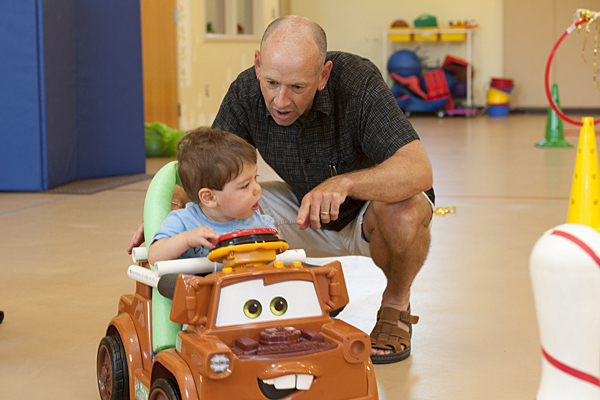
Dr. Cole Galloway, professor of physical therapy and University of Delaware, was been working to get around this predicament. Galloway saw that motorized chairs that would give some independence to users aren't usually available to kids until they are older, so he decided to develop his own chairs in a project called GoBabyGo. He quickly found that his high-tech robotics were too expensive and could not easily be produced in a volume that met demand, but eventually decided to try fixing up a product that was already on the market: battery powered toy cars.

Galloway and his tiny client in a converted Tow Mater toy.
Galloway took the Barbie Jeeps and Lightning McQueens and gave them a little race car tune up. The augmented toys have padded safety cages, seat belt harnesses, and custom driver controls to suit the users' needs. His cars are tested by his clients on both and indoor and outdoor tracks, and he even has traveling seminars to teach families how to convert their own motorized toys to make them more accessible.


It doesn't end here with Galloway. The success of GoBabyGo prompted him to design the prototype for UDare2B, aka Big Blue, a toy car with a specific purpose and a lot of tech. Big Blue's egg shape makes it look sleek, fierce, and futuristic, but it also acts as a support and a protective roll cage of sorts. It has an adaptive steering system that lets the controls be adjusted to the physical abilities of the driver. Additionally, the tight turning radius, compact size, and light weight make it highly maneuverable and suitable for indoor and outdoor use. Computerized monitoring in the cars log data to help researchers learn how they are being used by children.
UDare2Be / Big Blue

It seems like a pretty big undertaking, but the project could produce a working model of Big Blue in about a year if all goes well, and there is already commercial interest from adult mobility scooter companies. This would mean having clinically effective and real-world ready vehicles for young children, which is awesome.

What do you think of the design? How about Dr. Galloway's endeavor as a whole? Share your thoughts!

Friday, September 20, 2013

Whirlwind RoughRider: A Hardcore Set of Humanitarian Wheels


A remake of the 1960s television series, “Ironside”, a detective show whose protagonist is a wheelchair-bound paraplegic, will air on October 2nd. Of course, it doesn't come without a bit of controversy. Detective Ironside will be played by Blair Underwood rather than by a paraplegic actor. I could go into the various viewpoints on this subject and perhaps will at some other point, but today I would rather share some information about the rad company that made Underwood/Ironside's wheelchair.

Whirlwind Wheelchair International has been creating wheelchairs specially designed to accommodate users in developing countries for over 30 years. I don't know if I can properly explain how awesome these things are. Not only does Whirlwind help improve the lives of the disabled, it also promotes sustainable local economic growth by creating chairs that can be fixed by locals using materials that are easily obtained in a given area. The wheels are made from bicycle tires, which makes them affordable, easy to replace, and practical for travel on multiple road surfaces. Also, the bearings are the same used in Honda motorcycles, which are very common modes of transportation throughout the developing world.

The chairs are inexpensive and durable, and they are suited for the user's individual needs. For example, muddy or broken sidewalks with no curb ramps make standard hospital wheelchairs prone to tipping, but Whirlwind's RoughRider design has an extra long wheelbase for increased stability. Users can even climb down sidewalk curbs without fear of tumult.


Because of their easy maneuverability and functionality, Whirlwind's chairs allow users to be more active players in their communities and therefore increase their quality of life. One user even said, “In this chair, no one mistakes me for a beggar,” and an employee at a wheelchair shop was able to continue tending chickens in his backyard thanks to his dirt-friendly RoughRider.

And there's more! Whirlwind's chairs are adjustable to user's backs and have special pressure sore relief cushions. Both of these features make the chairs more comfortable and better suited for individual users, as adjusting the back to fit the contours of the user's spine helps prevent further injury and pain.

Also, these things are aesthetically pleasing. They look strong and mobile rather than stiff or clunky, which only adds to the appeal of these high-functioning wheelchairs. And, although they were originally designed for the developing world, RoughRiders are now available in the United States. I think they sound great for an Oregonian: outdoorsy, adventurous, and sustainable!

What do you think about Whirlwind's wheelchairs? Their philosophy? Or maybe you'd like to start a dialogue about Ironside? That would be great, too. :)


Friday, September 13, 2013

Gallaudet's Architecture Satisfies the Senses


I've heard it said before that our senses can actually limit us more than they help us. For example, the Who's famous rock opera, Tommy, expresses that life without sight, sound, or speech leads to enlightenment, and in one of my favorite childhood books, A Wrinkle in Time, a sightless character from another galaxy is vexed by the reliance of humans on their senses, claiming that they seem so constricting. Recently, architect David Lewis proposed that our senses have lowered our expectations for the quality of space in which we live and work.

Lewis is the lead architect at New York City-based LTL Architects and is at the front of Gallaudet University's newest residence hall. Gallaudet is home to almost 2,000 students who are deaf or hearing impaired, so it was important that the new hall follow the design principles of DeafSpace, an initiative created in 2005 by architect Hansel Bauman to develop architectural guidelines that improved interactions amongst the deaf community. DeafSpace's design elements address space and proximity, sensory reach, mobility and proximity, light and color, and acoustics, all of which can be issues for the deaf.

You wouldn't notice right off that the residence hall was designed specifically for deaf students. The first thing you might notice is how open and well-lit it is, or you might see that your skin has a healthy glow to it rather than the somewhat greenish tinge it takes on in white rooms with florescent lighting. Then you might say, “Wow” and notice that in spite of the open space, your utterance did not fly across the room in echo. Wouldn't it be nice if this were the case every time you walked in a building?


These appealing examples are the results of very intentional design choices to make Gallaudet's new dorm more accessible for its residents. Here are some of the key features of the building:

  • The community room on the ground floor has sloped ceiling that aligns perfectly with the inclines ground outside, and the wall is essentially a giant window. This way, people inside and outside the building can communicate with one another via sign language.


  • Similarly, the centrally located stairwell is transparent as well. Rather than a separated cement staircase (like, for example, the one in Neuberger Hall), this one is open, well-lit, and in the middle of the room, allowing for easier communication.


  • The 12-foot-wide hallways are twice as wide as standard halls.


  • The hall's kitchen has all appliances concentrated to an island in the middle so that students don't have to have their backs to one another.


  • The interior colors (red, yellow, green, and steel blue) were chosen to enhance natural skin tones in order to make facial expressions easier to read.


  • The ceiling is paneled, and an acoustic blanket sits under the concrete floor to enhance and tighten acoustics. This reduces the reverberations that can mess with hearing aids and, consequently, keeps voices from carrying across a room.


  • Unfortunately there were not enough funds for a huge skylight, but hey, maybe someday!


So here's what I'm thinking: Why aren't all new buildings following the DeafSpace guidelines? I think it sounds pretty good! It seems our senses let us build these obstacles—like dark, narrow halls and stairwells—simply because we can get around them without too much struggle or complaint. But why not make our space more beautiful, intuitive, and accessible for all people? 

Friday, September 6, 2013

Finding a Better Bottom Line


At the end of last week's post, I mentioned the new plan to increase the number of people with disabilities employed by companies that do business with the federal government. While this plan has a solid philanthropic base, companies like Walgreens are hiring more people with disabilities not out of moral obligation, but because it's economically sound.

Right now, companies are typically asked to employ people with disabilities out of kindness or civic responsibility. Even the aforementioned federal plan is more focused on philanthropy than smart business planning. Governor Jack Markell of Delaware thinks this mindset will soon change, and he hopes to galvanize that change with his blueprint, “A Better Bottom Line: Employing Individuals with Disabilities”.

Governor Markell talked with CEO of Walgreens, Greg Wasson, about his high percentage of employees with disabilities. Approximately 50 percent of employees at Walgreens distribution centers in Connecticut and South Carolina have some sort of mental or physical disability, and Wasson says it's no accident. Those centers perform as well as, if not better than, any other Walgreens facility. Markell also talked to Neill Christopher, vice president of Maryland company Acadia Windows and Doors. Christopher says that although he was at first reluctant to hire his first employee with a disability for fear that window manufacturing would pose too great a danger, he is now happy to report that six out of 60 employees have disabilities, and the company is operating more safely than ever. He also points out that, along with increased safety, his new employees make the company kinder.


Further, Computer Aid, Inc., an IT company, recently pledged to make people with autism three percent of their consultant base, and global software company, SAP, has also recognized that because of their focus and attention to detail, people with autism often excel at software testing.

After talking with company heads and seeing firsthand the gratitude and happiness of employed members of the disabled community, Markell teamed up with Governor Dennis Daugaard of South Dakota, who happens to be a CODA (child of deaf adults), to devise a blueprint that gives governors the necessary tools to increase employment within the disabled community. Markell says the real focus of the blueprint is on the ability and not the disability. (Three cheers for that!) He foresees the Department of Labor partnering with companies who are looking for employees with certain skills, disabled or not. It's what they are able to do that matters.

The blueprint also includes plans for better preparing youths with disabilities, hopefully encouraging employment and more independence through education and access to career opportunities and exploration.

Markell says the plan is a win-win. Employers will have qualified, specialized employees, and those employees will gain a certain sense of pride and fulfillment. Additionally, Markell notes that taxpayers also win as fewer people rely on benefits and join the workforce themselves.

I think the best part about this is that it seems so direct: the plan looks straight past disability and squarely at ability. That sounds like simple logic to me.

What do you think about this blueprint? Do you think it will catch on?