Friday, December 27, 2013

"They Said Yes!": A College Acceptance


Do you have post-holiday blues? Or maybe you're in good spirits and would like to stay that way? Luckily Mt. Hood Kiwanis Camp at Portland State has just the pick-me-up/keep-me-going for you!


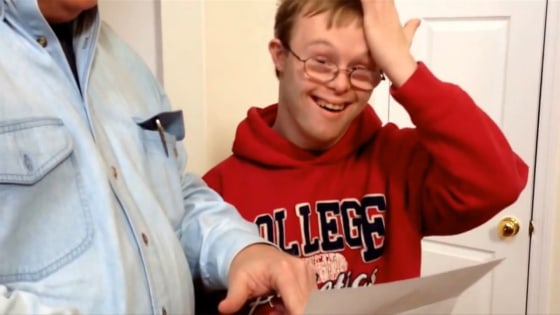
Rion when he hears the good news.
Rion Holcombe wasn't home when the envelope from ClemsonLIFE at Clemson University arrived, but his parents, Danny and Susan Holcombe, were. They knew that Rion, who has Down Syndrome, had been accepted to Clemson and were ready with camera when Rion eventually received the good news himself.

“I got accepted? They said yes?” Rion asks in tones of excited disbelief.

“They said yes!” Danny says. “What do you say?”

“Yes! This is crazy!”


Rion's parents say they are very excited for their son, but as parents, they are “not real excited about him leaving home.” However, they are extremely happy and thankful that their son actually has the opportunity to go to school, noting that at the time he was born, this would not have been possible.


ClemsonLIFE is a two year program at Clemson University in South Carolina that is specially designed for students with intellectual disabilities. It gives students the opportunity to live independently on campus while incorporating functional academics, employment skills and opportunities, social and leisure skills, counseling, and self-advocacy.

Rion couldn't be more excited to be part of the program.

“He's not looking back at all,” Danny says. “We asked him if he'd miss us, and his response was, 'Maybe eventually!'”


Friday, December 20, 2013

BlindSide: A Video Game Without Video


I am not a gamer by any means, and I'm not really up to date on the new consoles and technologies and what have you; Nintendo 64 is about all I can handle. However, my attention has just been caught by an awesome sounding (in more ways than one) thriller-horror game called Blindside.

BlindSide is an audio-only survival horror video game that doesn't actually feature any video. While many video games have accessibility options built into their programming, especially games for phones and tablets, BlindSide was designed specifically for the visually impaired.

In the game, Case, an assistant professor, and his girlfriend, Dawn, wake up inexplicably sightless. They aren't the only ones, either. Everyone in the city has become blind and must survive the menacing-sounding monsters that now roam around. Players must navigate Case by using audio cues from both Case and the environment. For example, since Case is new to being blind, he bumps into things around him and gives verbal hints about what he feels: “The door is to my left.” 

Environmental cues might be the sound of traffic as one approaches a window and the speaker in which those sounds are heard depending on the direction one turns. If one faces the window directly, sounds are heard in both ears, but if one turns to the right, the sound is isolated to the left speaker. Also, if using mobile devices, players can actually move themselves in order to move Case, rather than being confined to arrow keys on a computer. This element of mobility seems to help players, particularly sighted ones, get a clearer mental image of the environment.

Start screen for BlindSide's mobile app.

BlindSide was designed after Aaron Rasmussen, half of BlindSide's development team, was temporarily blinded after a red phosphorous and potassium chlorate explosion. After the emergency room drugs wore off, Rasmussen woke up to blackness. His corneas eventually grew back, but Rasmussen doesn't take advantage of his sight anymore: “The whole experience made me value my sight more, in a way that makes me treat it with more care.”

Rasmussen got together with a former colleague from Boston University, Michael T. Astolfi, and after raising over fourteen thousand dollars on Kickstarter in December, 2011, the two worked from their homes in Los Angeles (Rasmussen) and New York (Astolfi) for the next twelve months. They modeled real-world locations in 3-D and reproduced over a thousand sounds that would be heard in those environments, adjusting them to walk the line between authenticity and playability.

BlindSide won an innovation award at the Games for Change Festival in June and has been downloaded thousands of times on iOS and PC since its release last year. Rasmussen and Astolfi have no plans of making a sequel to the game, but they have helped the Smith-Kettlewell Eye Research Institute make an assistive app using the game's technology, and they hope that other gamers and independent game designers will continue designing accessible games that don't feel limited.

BlindSide is available at the iTunes App Store for $2.99 or on the BlindSide website for $3.99.

I'm extremely tempted to try it out; rumor has it BlindSide is pretty scary. Sounds good to me! What do you think?
Friday, December 13, 2013

Five-year-old CODA Spreads Holiday Cheer


Winter break has officially arrived for Portland State students! Here to help you get in the holiday spirit is Claire Koch, a five year old CODA (Child of Deaf Adults) from Toledo, Florida, who signed her entire holiday performance for her parents, who are both deaf.


Claire's parents posted the video of her performance after learning about the recent claims that the sign language interpreter at Nelson Mandela's memorial was a fake. Her mother, Lori, said, “It became obvious that he was making things up. He was repeating the same hand movements so it was obvious he was a fake.”

Claire's father agreed. “It was just totally deflating for deaf people, like saying deaf people are not important. [Mandela] is a famous man who did so much for many people.”

Lori Koch's immediate reaction to the Mandela interpreter controversy was to send a tweet with mixed tones of pride for her daughter and dismay at the disrespectful signer:

“Even my 5 yr old daughter signed better for her deaf parents in an xmas play.”


Video commenters have noted Claire's impressive grasp on ASL, sense of rhythm, and enthusiasm. Her future as a top signer looks promising.


What do you think about all of this? Any thoughts on the Mandela interpreter? It seems that Claire Koch might be a tiny restoration of hope that the deaf community (and the hearing community) needs after the disappointing situation at Mandela's memorial.

Friday, December 6, 2013

Because Who Is Perfect?


Another happy Friday to everybody! If you are in Portland, you might be too distracted by the snowy surprise nature left us this morning to read this, but I, as always, hope you find today's post worth your while.

Some of you may have seen the Dove Real Beauty blind portrait video that was passing its way through the internet not too long ago. In it, female participants were asked to do two things: describe their faces to a professional sketch artist, and get to know a stranger who was participating in the experiment as well. The strangers were also asked to describe the women's faces to the sketch artist, and the drawings were compared, revealing not only the women's insecurities about their physical appearances, but also their actual impressions on people.

Swiss organization for people with disabilities, Pro Infirmis, recently conducted a project with a similar feel to it. The project, entitled “Because Who Is Perfect? Get Closer”, involved creating a series of clothing mannequins of actual people with disabilities. Their goal was to raise awareness that nobody has a perfect, mannequin-esque body. Participants included notable members of the disabled community, like Miss Handicap winner Jasmine Rechsteiner and actor Erwin Aljukic, who had never seen their figures replicated before.


The most striking part of this project, though, was not the mannequins themselves, but what Pro Infirmis did with them. In honor of the UN's International Day of Persons with Disabilities, which was December 3rd, these unique mannequins were clothed and put in the window displays of stores along downtown Zurich's main street.

In the video that documents this project, some participants express their curiosities and doubt about the public's reaction to their mannequin selves. “I am keen to know whether people will see the disability,” one says, while another comments, “People passing by [the windows] will be really irritated.”

Passersby definitely took notice. Whether their reactions were mostly positive or negative is difficult to say, but it seems that Pro Infimis did what they set out to accomplish: bring attention to the disabled community, especially in the context of fashion.


Take a look at the video (my ultimate favorite part is at 2:34) and share your thoughts! What do you think about Pro Infirmis's project?

Friday, November 29, 2013

Abused "Warrior" Puppy and Boy with Autism Make Perfect Team


For the past few days, I've been debating whether or not to write about Black Friday, but then I thought, we already have a Black Friday post, and I'm actually pretty tired of the whole post-Thanksgiving shenanigans. Instead I bring to you an absolutely heartwarming story to make you feel happy to be a reasonable human instead of a bumbling bargain beast. Be it known I rarely call things “absolutely heartwarming” and actually mean it. This time, I mean it. I only hope I can relay to you the fuzzies this story gave to me.

This is Jonny Hickey before he met Xena:


And this is Xena before she met Jonny:


Jonny is an eight year old Georgia boy who has autism. Although Jonny can speak and read proficiently, he spent most of his life quiet and isolated, choosing solitary activities like playing with marbles over often painful social interactions.

Xena was a severely neglected puppy who was brought into DeKalb County Animal Services shelter in Georgia after collapsing from weakness in somebody's yard. She weighed four pounds and seemed unlikely to survive the night. However, with vet visits, nutritional supplements, and fluids, she pulled through and was named Xena the Warrior Puppy. A Facebook page was made in her honor, which is how Linda Hickey, Jonny's mom, found the dog that would change her son's life.

When Xena was strong enough, she made an appearance at a Friends of DeKalb Animals fundraising event, and Linda took her family to meet the puppy she had already fallen in love with on the internet.

“We were literally there for four minutes,” Hickey tells TODAY.com, “and Xena ran right up to Jonny and my husband.”

They adopted Xena soon after.

During their first trial day with the new puppy, Linda brought Xena with her to pick Jonny up from school. She instantly smothered him with kisses and unconditional affection and took her place sitting on Jonny's lap. “That's where she's been ever since.”

This is Jonny and Xena now that they've found each other.


Since Jonny met Xena, he has been his happiest. He is talkative, playful, and engaged, and he loves to sing and tell his family about the things he did in school on a given day. With Xena's help, Jonny's personal space issues have improved; Xena can usually be found leaning, sitting, or lying on Jonny. Even though they weigh nearly the same, Jonny seems to really appreciate the contact.

Since Xena met Jonny, she has gained her health and a needed friend who reciprocates her unconditional love. She was also recently named ASPCA Dog of the Year.


They are, as Jonny says, the perfect team.


Life-changing friendships...definitely something to be thankful for.  

Friday, November 22, 2013

Threading Straws Together


Hey everybody! A friend of mine shared this awesome video with me, and I thought it was definitely worth sharing with all of you. It is a little long, so I'm going to keep the text short in an attempt to encourage you to watch through the end.

Janine Shepherd had hopes of becoming an Olympian. She had always thought of her body as a machine; her athleticism defined her. But, of course, her life took an unexpected turn when, out on a bike ride, she was hit by a truck. Her machine was broken and would never be the same.

Watch this wonderful TED Talk to see what Janine did with her life. It's pretty amazing.


You are not your body!


Have a fantastic weekend, everyone! Don't forget to push yourself out of your comfort zone every once in a while. :)

Friday, November 15, 2013

Flo Fox: NY Photographer Worth Seeing


Here's to rad photographer (with a name to fit her sass), Flo Fox, who captures thought-provoking, often humorous images of New York street life in spite of a significant visual impairment, multiple sclerosis, and lung cancer.

If you were in New York recently and saw a purple-haired woman riding around the streets in a motorized wheelchair, camera around her neck, care assistant by her side, chances are you came across Flo Fox. Maybe she stopped in the middle of the street and urged her aide to grab the camera before the opportunity disappeared, describing the shot she wanted as her aide pointed the lens and snapped the photo. Perhaps she was even on a street corner, mixing cement so she could repair New York's broken sidewalks herself, since the city would not. That's her personality—big, audacious, and quirky, just like the city that seems to supply her with unending inspiration.

Fox has always been a little eccentric; she was orphaned as a teenager and ended up hanging out at Studio 54 in the same social crowds as Andy Warhol and photographers Andre Kertesz and Lisette Model. Fox claims she was raised by what would become the main focus of her photography: “I got my education on the streets. That's why I can take naughty photos.”


Fox was born blind in one eye and is now almost completely blind in the other. This early blindness is partly what drew her to photography. Fox says that being born blind in one eye was perfect for photography. She never had to close an eye to take a photo, and she never had to change three dimensions to a flat plane. It made sense, so when she was 26, she used her first paycheck to buy a camera.

Fox still takes photos and exhibits them—she even has permanent collections in both the Smithsonian and the Brooklyn Museum—but now she takes her photographs in a different way. Since her triplegia, caused by MS, makes it impossible for her to hold a camera, Fox instructs her aides to take the photos for her. She says that maybe one in ten turn out exactly as she'd hoped, and others just need cropping here or there. She is happy that she's been able to take so many photos.

“You have to take a look at what you can do with your life to keep your interests going.”


Take a look at this nice mini-documentary and let me know what you think!